Every couple in the Gulf eventually reaches the same moment in planning. A grandmother mentions what was done at her wedding, an aunt asks whether the coffee will be served the proper way, and the couple looks at each other and wonders how to keep what matters without building a wedding that looks like every other wedding they have attended.
It is a real tension, and it is worth taking seriously. Tradition carries meaning, and the people who love you will feel its absence if it is dropped without thought. But tradition repeated without thought can turn into a checklist, with the same stage, the same flowers, and the same arrangement of chairs, until the day belongs to the custom rather than to the couple.
There is a better way through. The most memorable Gulf weddings do not copy the past, and they do not ignore it. They ask what each custom was meant to express, then find a fresh way to express it. A tradition is a feeling that someone once found a form for, and the form can change while the feeling stays.
This guide looks at how to do that well. We cover what tradition really is, which rituals deserve to stay, how to bring heritage into a room through scent, sound, and texture, how colour and flowers can carry cultural meaning, how to bring generations together, and a simple method for deciding what to keep and what to reimagine.
Understanding What Tradition Actually Is
Most of us think of tradition as a set of objects and actions, such as the henna, the procession, the coffee, and the gold. But each of these began as an answer to a question. How do we welcome people? How do we show generosity? How do we mark a bride’s passage from one chapter of life to the next? The object is the answer. The question is what really matters.
Gulf culture is well placed to explain this, because its most treasured customs are about values rather than decoration. UNESCO has recognised several of them on its lists of intangible cultural heritage. Arabic coffee was inscribed in 2015 as a symbol of generosity, a joint nomination by Oman, Qatar, Saudi Arabia, and the UAE. The majlis, the gathering space at the centre of Gulf social life, was inscribed in the same year. The date palm, whose knowledge and traditions are shared across the Arab world, was inscribed in 2019 as a multinational nomination of fourteen countries. And in 2024, henna, with its rituals and social practices, was inscribed as well.
Look at that list again and notice what it describes. Generosity. Gathering. Nourishment. Blessing. None of these is a style. They are values, and values can be expressed in endless ways.
This is the key to designing a wedding that honours tradition without repeating it. If you copy the form, you inherit the look of the past. If you understand the value, you inherit its meaning and are free to create a new form for it. A couple who serves coffee because they want their guests to feel welcomed will find ten ways to do it beautifully. A couple who serves it because it is expected may find only one.
It also helps to remember that traditions were never frozen. Weddings in the Gulf were once celebrations that could stretch across several days, with different gatherings, different dress, and different music for each stage. Today most couples hold the celebration over a shorter span, and nobody considers that a betrayal of heritage. Customs have always adapted to the lives of the people keeping them. Choosing deliberately which parts to carry forward is simply the latest chapter in that story.
The Rituals Worth Keeping, and How to Reimagine Them
Not every custom needs to be reinvented. Some rituals are so central to the experience that their power comes from being recognisable. The skill lies in deciding which ones to keep close to their original form and which to approach with fresh eyes.
Start with the welcome. Offering Arabic coffee and dates to arriving guests is one of the clearest expressions of Gulf hospitality, and few guests would want it removed. What can change is the setting and the presentation. Instead of a table off to one side, the coffee can be served from a dedicated space near the entrance, designed as a quiet moment of arrival, with brass pots, simple glass cups, and a display of dates arranged like a still life. The gesture is unchanged, but the guest feels it more strongly because it has been given a place of its own.
Henna deserves similar thought. It is one of the most intimate wedding customs in the region, and in many families it has its own evening, gathered around the bride and the women closest to her. Rather than treating it as a smaller event attached to the main one, some couples design the henna night as a complete experience, with its own mood, its own palette, and its own flowers. The evening becomes less of a prelude and more of a chapter, with a character quite different from the main celebration, and that contrast gives both occasions more depth.
The procession that brings the couple into the room is another moment with room for creativity. Traditional performing arts have a long place in Gulf celebrations. Al Ayyala, a performance of drums, chanting, and a line of men moving together with sticks, is practised in both the UAE and Oman, and was inscribed by UNESCO in 2014. Many families would never imagine a wedding without some form of traditional performance. The question is how it enters the design of the evening. It can open the celebration with energy, it can accompany the couple’s entrance, or it can be saved for a moment later in the night when the room is ready for it. Placed with care, it feels like a gift to the guests rather than a duty to be completed.
The point is not that every ritual must be altered. Some should be done exactly as your family has always done them. The skill is in choosing which ones will be sacred and unchanged, and which ones will be given a new frame. When you make that choice on purpose, the whole wedding feels intentional.
Scent, Sound, and Texture: Bringing Heritage Into the Room Quietly
The most elegant way to honour tradition is often the least visible. A guest may not be able to say what makes a room feel unmistakably Gulf, yet they feel it the moment they walk in. The answer is usually found in senses other than sight.
Scent is the clearest example. Oud and bukhoor are woven into hospitality across the region, and the smell of them tells a guest, before anyone speaks, that they have arrived somewhere that values welcome. The trick is restraint. A heavy cloud of incense can overwhelm a room and a guest’s patience, while a gentle trail near the entrance, a carefully chosen fragrance in the bridal suite, or a faint note carried through the room by the staff creates a feeling of warmth without competing with the flowers. It is also worth asking where oud comes from. Agarwood, the resinous wood behind it, comes from trees whose species have been listed under Appendix II of the international wildlife trade convention, known as CITES, since 2004, which means trade is regulated to protect them. Choosing a supplier who can explain their sourcing is a small way of honouring a tradition responsibly.
Sound works in the same way. A room does not need loud, continuous music to feel cultural. A single oud player at the entrance, a gentle recital during dinner, or a moment of chanted poetry before the couple enters can bring heritage into the room without turning the entire night into a performance. Silence has its place too. Leaving a few minutes of quiet before a major moment lets the occasion breathe.
Texture is the third language, and it offers some of the richest material for a contemporary design. Al Sadu, the traditional weaving of the Bedouin communities, was recognised by UNESCO in 2011, with the UAE’s nomination listed as needing urgent safeguarding. Its geometric patterns, worked in bold bands of colour on handwoven cloth, can inspire table runners, cushion fabrics, napkin ties, or the border of a ceremony carpet. A design that borrows the rhythm of those patterns, rather than reproducing them literally, pays tribute to the craft without turning it into costume.
The same thinking applies to geometry. Latticework screens, the patterned shapes found in traditional Arab architecture, can be reinterpreted as a backdrop, a lighting detail, or a carved panel behind the couple. A guest will recognise it instinctively. They will not feel they are looking at a copy.
None of these details shouts. That is the point. A wedding designed this way has the confidence to let its heritage appear in small moments, and guests leave remembering a feeling instead of a theme.
Colour and Flowers: Ivory, Gold, Taif Roses, and Beyond
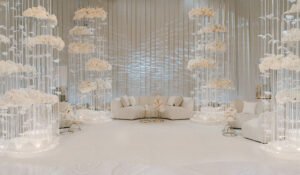
Colour is where many couples feel the most pressure, because the traditional palette is so beautiful and so widely used that choosing it can feel like surrender. The combination of ivory, cream, and gold has a long history in the design of ceremonial spaces in the region, and it is easy to see why. It suggests generosity and abundance, it looks warm in candlelight, and it flatters almost everyone in the room. Our Regal Wedding concept is built on exactly this foundation.
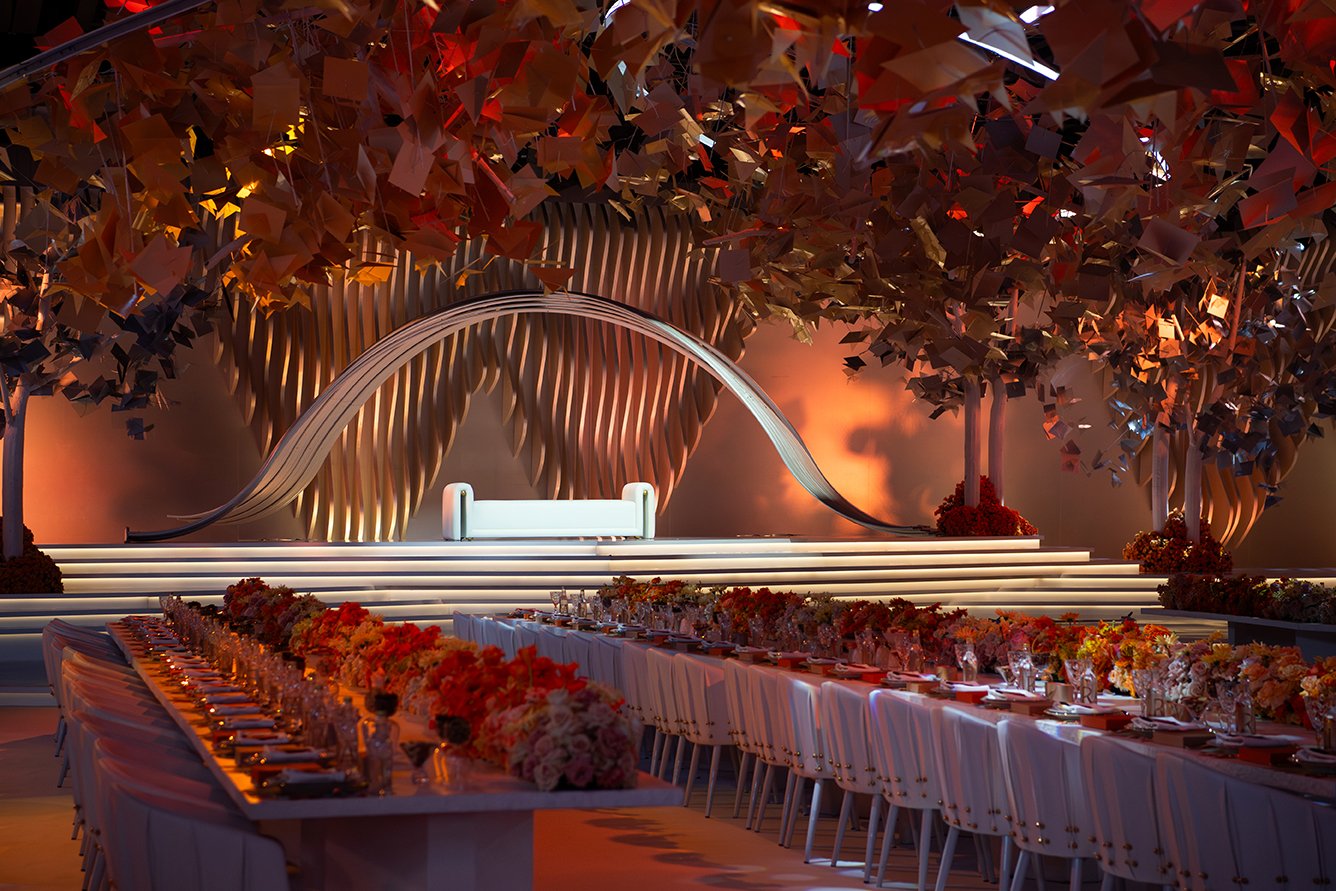
The question is not whether to use it but how. A palette becomes traditional through repetition, and it becomes personal through variation. Ivory and gold can be pushed toward a deeper, antique tone, softened with a muted rose, or grounded with a rich green. A single unexpected colour, used with discipline, can transform the whole mood. Our Ash of Roses concept shows how a dusty pink can live comfortably alongside ivory and antique gold and feel entirely fresh. A deeper wine and burgundy palette, as in Sealed with a Kiss, can carry the same sense of ceremony with a more intimate feeling.
Flowers offer the clearest opportunity to honour a place rather than a style. The Taif rose, a type of damask rose grown in the mountains around the Saudi city of Taif, is one of the most celebrated flowers of the Arabian Peninsula. It is harvested by hand in spring and is prized for its fragrance, which is used in perfumes and rosewater. Its season is short, and fresh Taif roses are not something to expect for every wedding, but their story suggests an approach. Look for flowers with a connection to the region’s own heritage, and build around the idea of fragrance rather than only appearance. Roses chosen for their scent, jasmine for its sweetness, and greenery that carries an aromatic note all bring the garden into the room.
Palms are another quiet link to heritage. Given the importance of the date palm in the culture of the region, palm fronds used as sculptural elements, in an arch, along an aisle, or as the structure behind a floral installation, bring a sense of place that no imported flower can. Dates themselves, arranged as part of a table or a welcome display, do the same.
Seasonality still matters, of course, and it helps to plan with it. Our guide to the season question covers which flowers are at their best in each part of the year. The principle is simple. Choose flowers that have a reason to be there, and a wedding will feel rooted rather than borrowed.
Honouring Two Generations at One Celebration
A wedding is rarely only about the couple. It is a gathering of families, and in the Gulf it is often a celebration that carries the expectations of several generations at once. This is one of the most delicate parts of the design, and one of the most rewarding when it is handled well.
Start by listening. The older members of a family usually care about a small number of things very deeply and are relaxed about the rest. A grandmother may insist on a certain song, a certain dress, or a certain way of serving the coffee, while having no strong opinion about the flowers or the lighting. Finding out which customs are essential to the people you love, before any design is drawn, saves a great deal of difficulty later. It also lets you protect those customs fully, which earns you far more freedom in everything else.
Many Gulf families still prefer to hold separate celebrations or separate areas for men and women, and this is a design question as much as a social one. A venue that has been planned with two experiences in mind, each with its own entrance, its own flow, and its own atmosphere, feels thoughtful rather than divided. It is worth giving both spaces equal care, so that neither feels like an afterthought. The mood and the palette can be shared, even if the layout is not.
Dress is another place where generations meet. Many brides honour their heritage through a garment, such as an embroidered Emirati thobe, which is traditionally worked with metallic thread, or through jewellery passed down in the family. Some choose a traditional piece for the henna night and a contemporary gown for the main celebration. Others combine the two, with a modern dress carrying a single inherited detail. Whatever the choice, giving the garment a place in the design, with a backdrop, a lighting moment, or a quiet photograph, tells the family their contribution is valued.
Finally, think about guests who may not know the customs. Many weddings in the region now include friends and colleagues from around the world, and a small card, a gentle explanation from the host, or a thoughtful welcome from the master of ceremonies can help everyone feel included. Hospitality is the heart of Gulf tradition, and explaining your customs to a guest is one more form of it.
A Simple Method for Deciding What Stays and What Changes
After all of these ideas, the practical question remains. How do you decide? A wedding can easily become overwhelmed by good intentions, with too many customs, too many references, and too little room to breathe. A simple method helps.
Begin by writing down every tradition you could imagine including. Do not edit yet. Include the ones your family expects, the ones you love, and the ones you have seen at other weddings and admired.
Next, sort each one into one of three groups. The first group is the essential customs, the ones that would feel wrong to leave out and that your family would notice immediately. These stay, and they are done with full respect. The second group is the customs you love but whose form could be refreshed, such as the welcome, the entrance, or the table styling. These are the ones to reimagine, using the ideas in this guide. The third group is the customs that are only there out of habit. Be honest about these. If no one in your family cares and you feel nothing when you imagine them, let them go.
Then check the balance. A wedding works best when tradition and freshness each have a clear place. If every element is traditional, the day can feel like a repeat. If almost nothing is, the family may feel left out. A good rule of thumb is to let tradition lead in the moments of ceremony and welcome, and let the couple’s own taste lead in the details that surround them.
Finally, test each decision with one question. Does this express a value we hold, or is it only a form we are repeating? If it expresses a value, find the most beautiful way to show it. If it is only a form, ask whether you need it.
This is the quiet discipline behind the weddings people remember. They do not feel old, and they do not feel invented. They feel true. The coffee is poured with care. The scent of the room is warm. A pattern from a grandmother’s weaving appears on a table, and an older guest notices it and smiles. The couple’s own story sits comfortably beside the stories that came before them.
That is what honouring tradition without repeating it really means. It is not a compromise between old and new. It is the confidence to take what you have inherited, understand why it mattered, and give it a form that belongs to your wedding and no one else’s.
Planning a Gulf wedding that respects your heritage and still feels entirely your own? Speak with the Worood team and we will help you shape a celebration that carries your family’s story forward.