A guest steps out of the car, smooths their dress or straightens their jacket, and walks toward a pair of doors. They have not yet seen the flowers, the stage, or the tables you spent months planning. They have not greeted a single member of your family. And yet something is already happening. Before the doors have fully opened, they have started to form a view of what kind of evening this will be.
Most couples spend their planning energy on the moments that last the longest, such as the ceremony, the dinner, and the dancing. These matter a great deal. But the entrance is the only moment every guest shares. Everyone arrives, everyone walks through the same threshold, and everyone has the same first look. It takes only a few seconds, and it sets the tone for how the rest of the night is read.
In this guide, we look at that moment the way a wedding designer does. We explain why first impressions form so quickly, why the doorway is a more powerful design tool than most people realise, what guests see, smell, and hear before they can name it, how the Gulf tradition of welcome shapes the entrance, and how to plan your own in a way that feels effortless on the day.
Why the First Ten Seconds Matter So Much
Let us begin with an honest note. The ten seconds in our title is a design unit, not a scientific measurement. It is our way of describing the stretch of time between the doors opening and the moment a guest has taken a few steps, looked around, and settled into the room. What science does tell us is that the mind forms impressions far faster than that.
In 2006, researchers led by Gitte Lindgaard published a study in the journal Behaviour and Information Technology. Participants were shown web pages for just 50 milliseconds, which is one twentieth of a second, and asked to rate how appealing they were. Their ratings were highly consistent with the ratings they gave after seeing the same pages for longer. In the same year, psychologists Janine Willis and Alexander Todorov reported in Psychological Science that judgments made after seeing a face for only 100 milliseconds closely matched judgments made with no time limit. Extra time did not change the verdict much. It mostly made people more confident in it.
Neither study was about weddings. One looked at screens and the other at faces. But together they point to a principle that designers have long observed in real rooms: people form a view before they have had time to think. Guests do not walk in, assess the details, and then decide how they feel. They feel first, and then spend the rest of the evening finding reasons.
There is a second body of research that explains why that first feeling lingers. In 1946, the psychologist Solomon Asch showed that the order in which information is presented changes how we judge a person. Traits mentioned first carried more weight than traits mentioned last. This is now known as the primacy effect. Later, in studies led by Daniel Kahneman and his colleagues, researchers found that people judge an experience mostly by its most intense moment and by how it ends, rather than by how long it lasted. This is often called the peak and end rule.
For a wedding, the lesson is practical. The entrance is not the whole day, but it is the first chapter, and the first chapter shapes how every later chapter is read. A guest who feels welcomed, calm, and curious in the first moments will interpret everything that follows more generously. A guest who feels rushed, confused, or underwhelmed will carry that feeling into the room, even if the flowers are magnificent.
This is also why the end of the evening deserves the same care as the beginning. We will return to that at the close.
The Threshold: Where the Outside World Ends and Your Wedding Begins
A doorway is more than an opening. It is a boundary, and the mind treats it that way.
In 2006, psychologist Gabriel Radvansky and his colleague at the University of Notre Dame published a study with a memorable title: walking through doorways causes forgetting. Participants who carried an object through a doorway were more likely to forget what they had been holding than those who walked the same distance within a single room. The researchers explained that the mind files experiences into separate scenes, and a doorway marks the point where one scene ends and another begins. The finding concerns memory for objects, so we should not stretch it too far. But it captures something every designer feels. When guests cross the threshold, they leave behind the car park, the traffic, the conversation about parking, and the phone call they were on. A new scene opens, and the entrance is its opening line.
This is especially important in the UAE, where the journey to the venue can be tiring. The UAE National Center of Meteorology reports average daytime highs above 40 degrees Celsius in July and August. A guest who walks from a car into a venue at that time of year is crossing from intense heat into cool air, and the entrance should treat that moment as a relief. Shade before the doors, cool air as they open, and a place to pause for a few seconds all make the arrival feel like a gift rather than a trial.
In winter, the challenge is different. Sunset in Dubai falls at around half past five in December, so many guests arrive as daylight is fading. They step from dim, cool air into a lit room, and the eye has work to do. Standard vision science tells us that the eye needs time to adjust between bright and dim light. The pupils respond within seconds, but complete adjustment to low light can take around half an hour. A sudden jump from bright to very dark leaves people blinking and unsteady, while a gradual change feels natural. This is why a good entrance is rarely a single door opening onto a single room. It is a sequence, with a lobby, a draped passage, or a soft corridor of light that lets the eyes and the mood adjust together.
Architects have long used a related idea. Often described as compression and release, it involves making an entrance low and narrow and then opening into a tall, generous space. The technique is often associated with Frank Lloyd Wright, and it works because the contrast makes the larger room feel even larger. There is also research on how ceiling height affects people. In a 2007 study in the Journal of Consumer Research, Joan Meyers-Levy and Rui Zhu found that higher ceilings encouraged freer and more abstract thinking, while lower ceilings encouraged more focused attention to detail. A lowered ceiling at the entrance, perhaps created with a canopy of fabric or a ceiling of hanging flowers, followed by the full height of the room, gives guests a small physical sense of arriving somewhere.
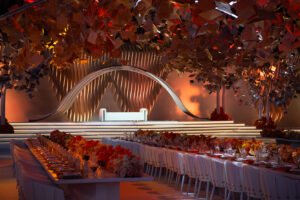
Our Sealed with a Kiss concept is built around exactly this idea of the threshold. Florals fall from above to form a canopy, and the architecture is designed to feel like a passage from one life into another. A couple does not need to copy that design, but the principle applies to any wedding. Treat the doorway as a moment, not a gap.
What Guests See First: Light, Height, and One Clear Focal Point
Once a guest has crossed the threshold, their eyes begin to move. Where they land first, and how long they stay, is something a designer can plan.
Attention research consistently shows that the eye is drawn first to the brightest area, the strongest contrast, and the largest shape in view. This means a room has a hierarchy, whether or not anyone designed one. If you do not choose the first thing guests see, the room will choose for you. It might be a bright exit sign, a stack of chairs, a catering door, or a crowded welcome table. The aim of an entrance design is to make sure the first thing is something you chose.
The simplest method is to give the entrance one clear focal point. This might be a large floral installation, a lit sculptural piece, a mirror that doubles the light of the room, a framed view of the stage, or a single long table with candles at different heights. One strong element reads as confident. Five competing elements read as noise. A guest who sees one beautiful thing will feel the whole room is beautiful, even before they have seen the rest of it.
To find the right focal point, stand at the main door and look at what is directly ahead. This is the sightline guests will see in their first moment, and it is where the design should be strongest. Many venues have a natural focal point already, such as a staircase, a chandelier, or a wall of windows, and the best entrance designs work with it rather than against it.
Light is the second tool. Warm light flatters people and flowers alike, and a soft glow at the entrance tells guests they have arrived somewhere welcoming. Harsh, flat light, like the lighting in an office corridor, does the opposite, and no amount of floral work will rescue it. Candles, lanterns, and low pools of light along the walls create depth and lead the eye forward. Light should also be layered, so that the entrance is slightly softer than the main room and the main room builds gradually towards the stage or the dance floor.
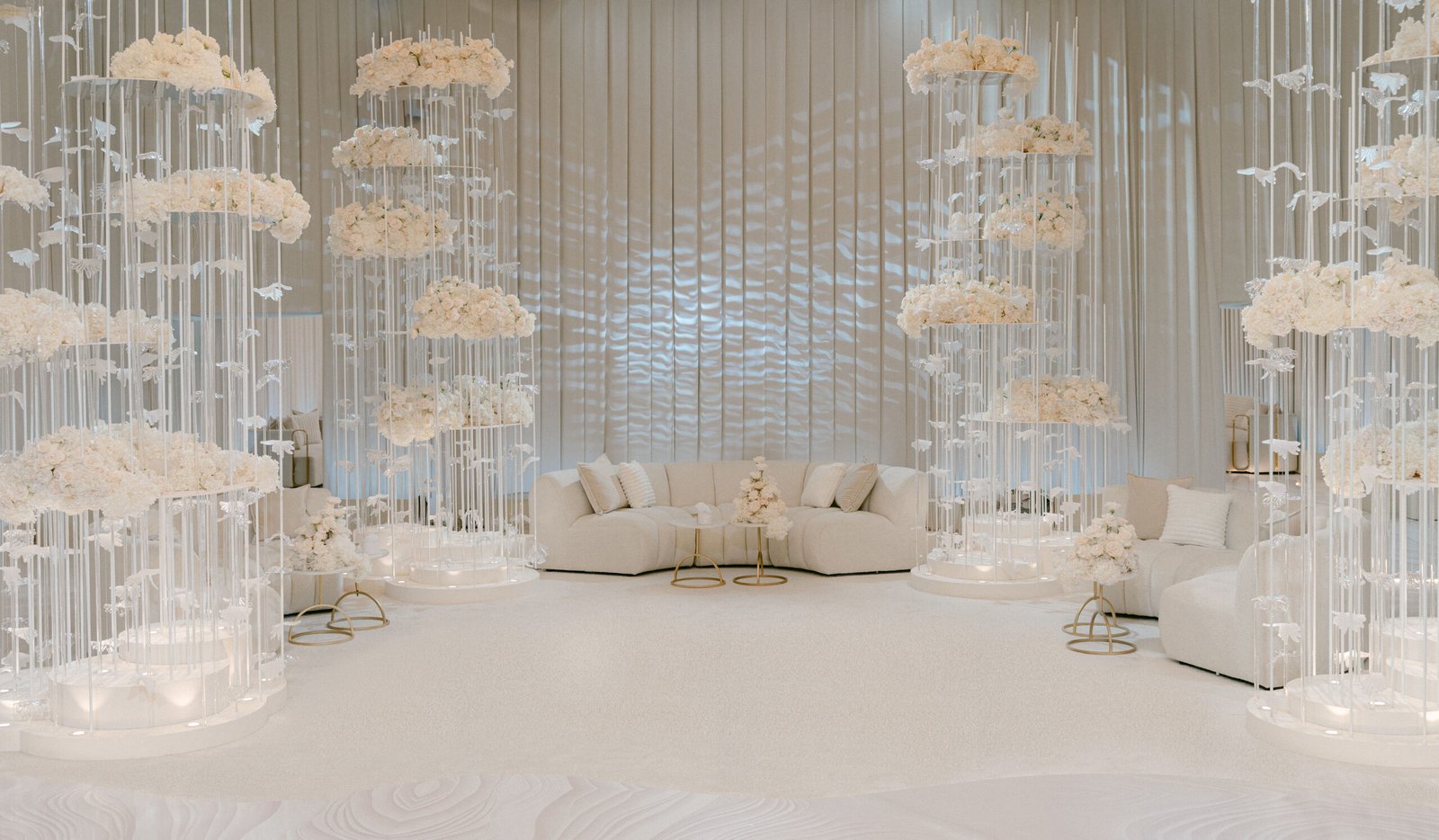
Scale deserves attention too. A tall installation near the entrance draws the eye upward, which makes a room feel grand. A low, wide arrangement draws the eye outward, which makes a room feel intimate. Our Regal Wedding concept uses architectural stage structures and cascading florals to command a large room, while our Dainty Blossoms concept does the opposite, using single stems, small clusters, and open space so that a guest leans in to notice each detail. Neither is better. What matters is that the entrance matches the character of the evening, so the first look tells the truth about what follows.
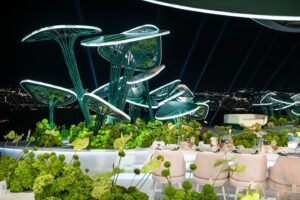
Our Grandeur of Night concept shows another approach. Instead of one focal object, it uses low chandeliers that create pools of warm light across each table, so the focal point is the light itself. For evening weddings, this can be the most beautiful option of all, because the room feels like theatre before anyone has said a word.
Finally, keep the practical elements quiet. Seating charts, welcome signs, and guest books are necessary, but they should support the entrance rather than dominate it. Place them to one side, where guests can stop without blocking the flow, and keep the main sightline clear.
What Guests Smell and Hear Before They Understand Why
Sight gets most of the attention in wedding design, but the senses that work more quietly often leave the deepest impression.
Scent has a particular power. The nerve pathways that carry smell are closely connected to the parts of the brain involved in emotion and memory, which is why a fragrance can bring back a moment from years ago with surprising clarity. Psychologist Rachel Herz has studied this for many years, and her research with colleagues has found that memories triggered by smell tend to feel more emotional than memories triggered by other cues. For a wedding, this means the scent of the entrance is not a small detail. It is part of how your guests will remember the day.
The best approach is gentle and consistent. Choose one fragrance direction and let it run through the entrance, so that it feels like the signature of the evening rather than a collision of smells. Fragrant flowers such as garden roses, jasmine, and tuberose do part of the work, and a light trail of oud or bukhoor near the entrance connects the room to Gulf hospitality. We discussed this in our guide to honouring tradition without repeating it. The key word is restraint. A heavy cloud of incense can overwhelm guests and compete with the flowers, and some guests are sensitive to strong fragrance. A faint note at the door, which fades as people move into the room, is almost always more elegant than a strong one.
Sound works in a similar way. Many couples think of music only as a performance, but the sound of the entrance sets the mood in the same way light does. A single oud player, a quiet instrumental piece, or a soft recording at a low volume tells guests the evening is going to be gracious. If the music at the entrance is louder than the conversation, guests will raise their voices to be heard, and the whole arrival will feel rushed. The goal is to keep it just below the level of conversation, so people can greet each other comfortably.
It also helps to understand what a room does to sound. Hard surfaces such as marble, glass, and polished stone bounce sound back, which is why large halls with these materials can feel echoing and tiring. Soft materials such as carpet, drapery, and upholstered furniture absorb it. This is why a draped entrance, a runner on the floor, and fabric on the walls change how a room sounds as much as how it looks. Guests will not notice the softness of the sound. They will simply feel calmer.
A last point on the senses is temperature. After the intense heat of the car park, a room that is slightly cooler than expected feels like luxury. After a cold evening, a room with a gentle warmth does the same. Coordinate with the venue so that the entrance is comfortable at the exact hour guests arrive, not just at the time of the walkthrough.
Two Entrances: Your Guests’ and Your Own
A wedding has two entrance moments, and they call for different design thinking.
The first is the guests’ arrival, where the theme is welcome. In the Gulf, welcome has a tradition behind it that is deeper than any design trend. UNESCO recognised Arabic coffee in 2015 as a symbol of generosity, in a joint nomination by Oman, Qatar, Saudi Arabia, and the UAE. Offering coffee and dates at the door is one of the clearest ways to tell a guest they are valued. The way it is offered makes all the difference. A dedicated welcome space near the entrance, with brass pots, small cups, and dates arranged with care, turns a familiar custom into a moment of arrival.
The people who offer the welcome matter as much as the objects. The first person a guest meets sets the tone for the evening. A warm greeting within a few seconds of arrival, a smile, and a clear gesture toward where to go next are worth more than any floral arrangement. Brief your team on this before the day. Ask them to greet guests promptly, to know where everything is, and to be ready to help elderly guests, families with children, and anyone unfamiliar with the venue.
Think also about flow. When many guests arrive at once, a narrow entrance with a welcome table in the middle creates a queue, and a queue is the opposite of a welcome. Leave space to stop, space to greet, and space to move on. A good test is to imagine twenty guests arriving together and ask where they would stand.
The second entrance is your own, and here the theme is anticipation. In many Gulf celebrations, the entrance of the bride is the most awaited moment of the evening, often accompanied by music and by family and friends walking with her. Traditional processions with drums and singing have a long history in Arab weddings, and many families would not imagine the evening without one. Al Ayyala, a traditional performance of drums, chanting, and movement practised in the UAE and Oman, was inscribed by UNESCO in 2014. How you bring such a moment into the room is a design choice.
Several decisions shape it. The length of the walk matters, because a longer path builds anticipation, and a short one makes the moment brief. Light matters too. Dimming the room slightly, or lighting the path while the rest of the room softens, tells guests where to look. Flowers along the way can mark the route and add scent. And the sightline matters most of all. Make sure every guest can see, and that photographers have a clear view, which sometimes means leaving the aisle free of tall arrangements.
If the entrance is held outdoors in summer, keep the route short and shaded, or move it inside. A bride in heavy fabric walking a long path at 40 degrees will not feel as radiant as she should. Even in winter, consider the wind and the surface under her feet. The beauty of the moment depends on comfort, and comfort should be planned as carefully as the flowers.
This second entrance is also one of the peaks of the evening, in the way Kahneman’s research describes. Guests will remember it more clearly than most other parts of the night, which makes it worth the time and attention it takes to get right.
Common Mistakes, and a Simple Plan for Designing Your Own
After many weddings, certain mistakes appear again and again. Most can be avoided with a little thought.
The first is too many focal points. When the entrance includes a large installation, a heavy welcome sign, a long table of decorations, and a display of photographs, the eye has nowhere to rest. Choose one strong element and let everything else support it.
The second is lighting that was planned for the walkthrough rather than for the evening. A room tested at two in the afternoon will look very different at six, when daylight has changed and the lights are on. Always check the entrance at the hour guests will arrive.
The third is a crowded welcome space. Welcome tables, seating charts, and guest books placed directly in the main path cause guests to bunch up and stop. Move them to the side, and give them room.
The fourth is overpowering scent or sound. Both should be strong enough to be noticed and quiet enough to be forgotten. If you can smell the incense from the car park or hear the music from the lobby over a conversation, turn it down.
The fifth is ignoring practicalities. Think about the surface underfoot, especially for guests in heels, and about whether a runner lies flat. Think about where coats and bags can go, and about shade, seating, and water for guests who have travelled far.
With those mistakes in mind, here is a simple plan.
Begin with a single sentence that describes how you want guests to feel in their first ten seconds. It might be “calm and welcomed,” or “amazed, then curious,” or “warm, like arriving at a family home.” Every decision that follows should serve that sentence.
Next, walk the route as a guest would, from the car to the doors to the first step inside. Look at what you see, listen to what you hear, and notice what you smell. Do this at the time of day your guests will arrive, and notice what changes.
Then choose one focal point, one fragrance direction, and one sound level. Avoid adding more until these three are right.
After that, plan the welcome. Decide who greets guests, what is offered, and where people can pause. Rehearse it with your team.
Finally, plan your own entrance with the same care. Decide on the route, the light, the music, and the sightlines, and walk it at least once before the day.
The entrance is only the beginning, and the peak and end research reminds us that the way an evening finishes matters just as much. A soft closing moment, such as a final song, a lit exit, a small gift at the door, or a farewell from the family, completes the story that the entrance started. Guests who arrive with warmth and leave with warmth remember the whole evening as warm.
That is the quiet purpose of designing the first ten seconds. It is not about making a grand statement. It is about telling every guest, before a word is spoken, that they were expected and that someone thought about their arrival. When that feeling is right, the rest of the wedding has a generous place to begin.
Planning an entrance that sets the right tone for your wedding in Dubai or across the UAE? Speak with the Worood team and we will help you design the moment your guests will remember first.